BỎ TÚI 35+ TỪ VỰNG MAP IELTS WRITING TASK 1
Trong IELTS Writing Task 1 – dạng Map, thí sinh không chỉ cần mô tả đúng sự thay đổi mà còn phải dùng từ vựng đa dạng, học thuật và chính xác. Việc lặp lại các từ đơn giản sẽ khiến bài viết khó đạt band cao. Dưới đây IEEP đã tổng hợp cho bạn 35+ từ vựng quan trọng thường dùng khi mô tả bản đồ, giúp bài viết mượt hơn và ghi điểm tốt hơn với giám khảo.
I. Từ vựng
1. Từ vựng Map IELTS Writing Task 1 – cơ sở hạ tầng
Roundabout /ˈraʊndəbaʊt/: Vòng xoay giao thông.
Example: Take the third exit at the roundabout. (Đi theo lối ra thứ ba tại bùng binh.)
Bridge /brɪdʒ/: Cầu.
Example: The Golden Gate Bridge is a suspension bridge in San Francisco. (Cầu Cổng Vàng là một cây cầu treo ở San Francisco.)
Bus stop /bʌs stɒp/: Trạm xe buýt.
Example: The bus stop is located outside the shopping center. (Trạm xe buýt nằm bên ngoài trung tâm mua sắm.)
Airport /ˈeəpɔːt/: Sân bay.
Example: The airport has several shops and restaurants. (Sân bay có một số cửa hàng và nhà hàng.)
Car park /kɑː ˈpɑːk/: Bãi đỗ xe.
Example: The car park is located behind the supermarket. (Bãi đậu xe nằm phía sau siêu thị.)
Square /skweə(r)/: Quảng trường.
Example: The town square is surrounded by shops and restaurants. (Quảng trường thị trấn được bao quanh bởi các cửa hàng và nhà hàng.)
Park /pɑːk/: Công viên.
Example: The city park is a popular spot for picnics and outdoor activities. (Công viên thành phố là một địa điểm phổ biến cho các buổi dã ngoại và các hoạt động ngoài trời.)
Beach /biːtʃ/: Bãi biển.
Example: The beach is crowded with sunbathers and swimmers during the summer. (Bãi biển đông đúc người tắm nắng và bơi lội trong suốt mùa hè.)
Harbor /ˈhɑːbə(r)/: Bến cảng.
Example: The harbor is home to a bustling fishing industry and a ferry terminal. (Bến cảng là nơi có ngành công nghiệp đánh cá nhộn nhịp và bến phà.)
Stadium /ˈsteɪdiəm/: Sân vận động.
Example: The stadium can seat up to 50,000 spectators and hosts major sports tournaments. (Sân vận động có thể chứa tới 50.000 khán giả và tổ chức các giải đấu thể thao lớn.)
2. Từ vựng Map IELTS Writing Task 1 – miêu tả vị trí của địa điểm
Located /ləʊˈkeɪtɪd/: Nằm ở vị trí.
Example: The hotel is located in the heart of the city, near popular tourist attractions. (Khách sạn tọa lạc ngay trung tâm thành phố, gần các điểm du lịch nổi tiếng.)
Adjacent /əˈdʒeɪsnt/: Tiếp giáp.
Example: The apartment building is adjacent to a park, providing residents with easy access to green space. (Tòa căn hộ liền kề công viên giúp cư dân dễ dàng tiếp cận với không gian xanh.)
Surrounded /səˈraʊndɪd/: Bao quanh.
Example: The castle is surrounded by a moat, making it difficult for attackers to breach its walls. (Lâu đài được bao quanh bởi một con hào, khiến những kẻ tấn công khó có thể chọc thủng tường thành.)
Bordering /ˈbɔːdərɪŋ/: Tiếp giáp.
Example: The neighborhood is bordering a river, providing residents with scenic views and recreational opportunities. (Khu phố giáp với một con sông, mang đến cho cư dân những khung cảnh tuyệt đẹp và cơ hội giải trí.)
Centrally located /ˈsentrəli ləʊˈkeɪtɪd/: Nằm ở vị trí trung tâm.
Example: The hotel is centrally located, making it easy for guests to explore the city's sights and attractions. (Khách sạn có vị trí trung tâm, giúp du khách dễ dàng khám phá những danh lam, thắng cảnh của thành phố.)
In the vicinity of /ɪn ðə vɪˈsɪnəti əv/: Ở gần.
Example: The school is in the vicinity of several parks and playgrounds, providing students with ample opportunities for outdoor activities. (Trường nằm gần một số công viên và sân chơi, mang đến cho học sinh nhiều cơ hội cho các hoạt động ngoài trời.)
At the heart of /æt ðə hɑːt əv/: Ở trung tâm.
Example: The theater is at the heart of the city's cultural district, attracting audiences from near and far. (Nhà hát là trung tâm của khu văn hóa thành phố, thu hút khán giả gần xa.)
Alongside /əˌlɒŋˈsaɪd/: Bên cạnh.
Example: The bike path runs alongside the river, providing cyclists with a scenic and safe route. (Con đường dành cho xe đạp chạy dọc theo dòng sông, cung cấp cho người đi xe đạp một tuyến đường đẹp và an toàn.)
In the midst of /ɪn ðə mɪdst əv/: Giữa.
Example: The museum is in the midst of a bustling downtown area, surrounded by shops, restaurants, and other attractions. (Bảo tàng nằm giữa khu vực trung tâm nhộn nhịp, xung quanh là các cửa hàng, nhà hàng và các điểm tham quan khác.)
On the outskirts of /ɒn ði ˈaʊtskɜːts əv/: Ở rìa thành phố.
Example: The factory is on the outskirts of town, away from residential areas and other businesses. (Nhà máy ở ngoại ô thị trấn, cách xa khu dân cư và các doanh nghiệp khác.)
3. Từ vựng Map IELTS Writing Task 1 – miêu tả phương phướng
North /nɔːrθ/: Phía bắc.
Example: The park is located in the north of the city. (Công viên nằm ở phía bắc thành phố.)
South /saʊθ/: Phía nam.
Example: The beach is to the south of the hotel. (Bãi biển nằm ở phía nam khách sạn.)
East /iːst/: Phía đông.
Example: The museum is located in the east of the city. (Bảo tàng nằm ở phía đông thành phố.)
West /wɛst/: Phía tây.
Example: The airport is to the west of the city center. (Sân bay nằm ở phía tây trung tâm thành phố.)
Northwest /ˌnɔːθˈwɛst/: Tây bắc.
Example: The park is located in the northwest corner of the city. (Công viên nằm ở góc tây bắc thành phố.)
Northeast /ˌniːsˈt/: Đông bắc.
Example: The university is situated in the northeast part of the town. (Đại học đặt tại khu vực đông bắc thị trấn.)
Southwest /ˌsaʊθˈwɛst/: Tây nam.
Example: The stadium is to the southwest of the city. (Sân vận động nằm ở phía tây nam thành phố.)
Southeast /ˌsiːsˈt/: Đông nam.
Example: The hotel is located in the southeast corner of the island. (Khách sạn nằm ở góc đông nam của hòn đảo.)
4. Từ vựng Map IELTS Writing Task 1 – miêu tả hành động và sự thay đổi
Expand /ɪkˈspænd/ (v): Mở rộng.
Example: The city plans to expand the highway to ease traffic congestion. (Thành phố có kế hoạch mở rộng đường cao tốc để giảm bớt tắc nghẽn giao thông..)
Renovate /ˈrɛnəveɪt/ (v): Cải tạo, sửa chữa.
Example: The old building was renovated and converted into a modern office complex. (Tòa nhà cũ đã được cải tạo và chuyển đổi thành một khu phức hợp văn phòng hiện đại.)
Demolish /dɪˈmɑlɪʃ/ (v): Phá huỷ, đập phá.
Example: The abandoned factory was demolished to make way for a new shopping center. (Nhà máy bỏ hoang đã bị phá bỏ để nhường chỗ cho một trung tâm mua sắm mới.)
Reconstruct /ˌriːkənˈstrʌkt/ (v): Xây lại, tái thiết.
Example: The historic bridge was reconstructed using original materials to preserve its authenticity. (Cây cầu lịch sử đã được xây dựng lại bằng vật liệu gốc để bảo tồn tính xác thực của nó.)
Upgrade /ˈʌpɡreɪd/ (v): Nâng cấp, nâng cấp phiên bản.
Example: The airport plans to upgrade its facilities to accommodate more passengers. (Sân bay có kế hoạch nâng cấp cơ sở vật chất để phục vụ nhiều hành khách hơn.)
Redesign /ˌriːdɪˈzaɪn/ (v): Thiết kế lại.
Example: The company hired a consultant to redesign their logo and branding. (Công ty đã thuê một nhà tư vấn để thiết kế lại logo và thương hiệu của họ.)
Install /ɪnˈstɔːl/ (v): Lắp đặt, cài đặt.
Example: The school installed new computers in all the classrooms. (Nhà trường đã cài đặt máy tính mới trong tất cả các phòng học.)
Dismantle /dɪsˈmæntl/ (v): Tháo dỡ, gỡ bỏ.
Example: The old playground equipment was dismantled and replaced with new equipment. (Thiết bị sân chơi cũ đã được tháo dỡ và thay thế bằng thiết bị mới.)
Merge /mɜːrdʒ/ (v): Sáp nhập, hợp nhất.
Example: The two companies merged to create a larger, more competitive company. (Hai công ty sáp nhập để tạo ra một công ty lớn hơn, cạnh tranh hơn.)
Convert /kənˈvɜːrt/ (v): Chuyển đổi, chuyển đổi mục đích sử dụng.
Example: The old church was converted into a community center. (Nhà thờ cũ đã được chuyển đổi thành một trung tâm cộng đồng.)
II. Bài mẫu
|
You should spend about 20 minutes on this task. The map below shows the development of the village of Ryemouth between 1995 and present. Summarise the information by selecting and reporting the main features and make comparisons where relevant. Write at least 150 words. |
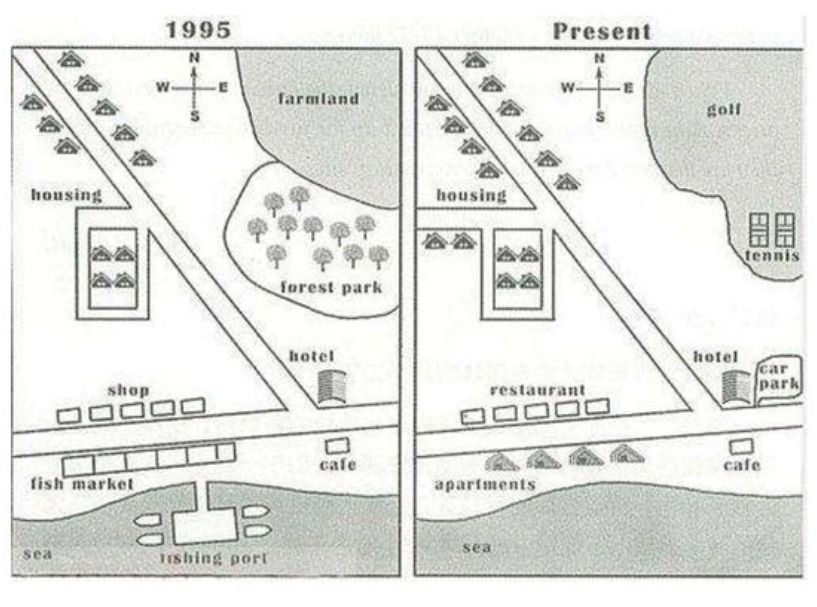
The map shows how a village called Ryemouth has developed over the last twenty-five years. There have been several changes, the most noticeable being the increases in accommodation, the elimination of the fishing industry, and the introduction of sports facilities.
In 1995, to the south of the village where the sea is there was previously a fishing industry, with a fishing port and quite a large fish market as well. Next to this was a small cafe. On the other side of the road running by the sea stood a line of five shops and a hotel, while situated in the north east part of the village was farmland and a park with trees. The main housing of the village was located in the north west around a main road that runs from the coastal road, with twelve houses, four of them encircled by a smaller side-street.
Turning to the present day map, it can be seen that the fishing facilities have all gone, being replaced by four apartments, and the shops have become restaurants. The cafe remains, as does the hotel, albeit with parking facilities which it did not have before. Having been converted into a golf course, the farmland has now gone, while the forest park has been removed to make way for tennis courts. Although the old houses remain, new ones have been built, along with a new road with two new houses beside it.
(240 Words)
Hy vọng rằng bài viết này sẽ giúp ích cho các bạn trong quá trình ôn luyện kỹ năng IELTS Writing Task 1, đặc biệt là phần miêu tả và sử dụng từ vựng Map IELTS Writing Task 1 phù hợp. Hãy rèn luyện và nâng cao trình độ tiếng Anh để đạt được mục tiêu band điểm bạn nhé!
Thông tin liên hệ & hỗ trợ tư vấn:
TRUNG TÂM NGOẠI NGỮ VÀ TƯ VẤN DU HỌC IEEP
Địa chỉ: Phòng 102 - Tòa C6 - Trường Đại học Công nghệ Thông tin và Truyền thông Thái Nguyên
Fanpage: Ngoại ngữ và Du học IEEP
Hotline: 02083 900 879 | 0963 900 879
Email: daotao.ieep@gmail.com | Zalo: 0963 900 879 (IEEP CENTER)